Open to Desire by Mark Epstein MD
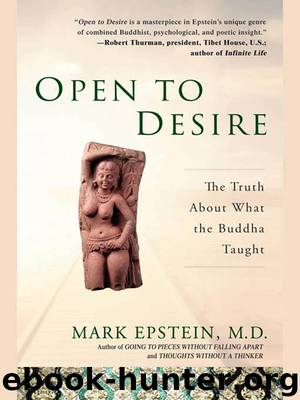
Author:Mark Epstein, MD
Language: eng
Format: epub
Publisher: Penguin Publishing Group
TAPAS AND KAMA
This understanding of the interrelationship of abstinence, or renunciation, and empathy has a very clear foundation in the Indian spiritual traditions. Restraining the actions provoked by clinging allows desire to function in a new way. Restraint brings about a restructuring of subjective experience. Rather than compulsively seeking satisfactions that can only eventually disappoint, restraint keeps people closer to their emotional vulner-abilities. As the Dalai Lama pointed out, this can be sad, but ultimately a relief.
The psychoanalytic world also has a tradition that recognizes the interrelationship of renunciation and desire. There is a saying in psychotherapy, growing out of the work of D. W. Winnicott, that at the center of each person is what is called an incommunicado element, an isolation that is impossible to breach, a matrix of emotional experience that can never be fully communicated. Winnicott’s descriptions of the incommunicado element were moving because of the way in which he fearlessly refered to it as sacred. In psychoanalysis, to refer to anything as sacred is virtually taboo. But Winnicott recognized what happens all too often to children like my patient Bonnie. Cut off from themselves because of the traumas that unfold in their early lives, they learn to put on a mask in order to cope with the demands of their worlds. They do this to survive, but lose touch with the vast, vulnerable potential that was their birthright. To be cut off from one’s self like this is to set up a scenario of clinging, as exemplified by the Hungry Ghosts. Bonnie did not know that she was cut off from herself, she just knew that she did not feel good. She wanted to feel better and turned to whatever she could think of: food, relationships or therapy. But Winnicott, in his writings on the sacredness of the incommunicado element, knew something that the Dalai Lama and the whole tradition of Indian spirituality also understand: In order to feel better, she had to learn how to go within.
Sometimes, the subtlety of the renunciation required by the path of desire can be surprising. The acting out provoked by clinging does not always take the form of addictive behaviors—it often is restricted to compulsive thoughts. But the consequences are the same—a person so afflicted is handcuffed by these reactions. Desire is so restricted that the spirit of emergence cannot be born.
A patient of mine, a painter in her early thirties named Amanda, discovered a version of this at a recent meditation retreat. Amanda was an accomplished yoga student who had a natural ease with meditation. She could sit serenely in the meditation hall for hours without moving and exhibited a grace that was the envy of many of her peers. At this retreat, a ten-day silent Buddhist exercise in mindfulness, in which an effort is made to attend to whatever is happening in the mind and body throughout the day in the style originally taught by the Buddha, Amanda was taught a technique of noting, or labeling, whatever she was aware of.
Download
This site does not store any files on its server. We only index and link to content provided by other sites. Please contact the content providers to delete copyright contents if any and email us, we'll remove relevant links or contents immediately.
Unwinding Anxiety by Judson Brewer(73185)
The Art of Coaching by Elena Aguilar(53410)
The Fast Metabolism Diet Cookbook by Haylie Pomroy(21181)
Rewire Your Anxious Brain by Catherine M. Pittman(18708)
Healthy Aging For Dummies by Brent Agin & Sharon Perkins RN(17069)
Talking to Strangers by Malcolm Gladwell(13438)
The Art of Thinking Clearly by Rolf Dobelli(10596)
Mindhunter: Inside the FBI's Elite Serial Crime Unit by John E. Douglas & Mark Olshaker(9418)
Crazy Rich Asians by Kevin Kwan(9345)
The Compound Effect by Darren Hardy(9049)
Tools of Titans by Timothy Ferriss(8486)
Periodization Training for Sports by Tudor Bompa(8325)
Becoming Supernatural by Dr. Joe Dispenza(8277)
Wonder by R. J. Palacio(8165)
Bodyweight Strength Training by Jay Cardiello(7968)
Crystal Healing for Women by Mariah K. Lyons(7965)
Change Your Questions, Change Your Life by Marilee Adams(7846)
Nudge - Improving Decisions about Health, Wealth, and Happiness by Thaler Sunstein(7758)
Therapeutic Modalities for Musculoskeletal Injuries, 4E by Craig R. Denegar & Ethan Saliba & Susan Saliba(7744)
